Showing posts with label oncogenes. Show all posts

Cancer

Cancers arise when cells escape normal controls on cellular proliferation.

Cancer is not a single disease, rather the term encompasses a group of conditions that share the characteristic process of uncontrolled proliferation of cells that are typically capable of local infiltration into other tissues (invasion). This propensity for invasion and migration is associated with the capacity of malignant tumors to metastasize to sites distant from the point of origin.

This propensity for invasion and metastasis is a critical feature that distinguishes malignant tumor from benign tumors. Benign tumors evidence as local overgrowth, but fortunately have minimal or no propensity for tissue infiltration and metastasis.

Cancers are named for the tissue/organ in which they originate. However, the tissue type of cancers from a particulary organ can vary, and even cancers of the same tissue type can vary considerably in degree of undifferentiation, sensitivity to chemotherapeutic agents, growth rate, invasiveness, and metastatic potential.

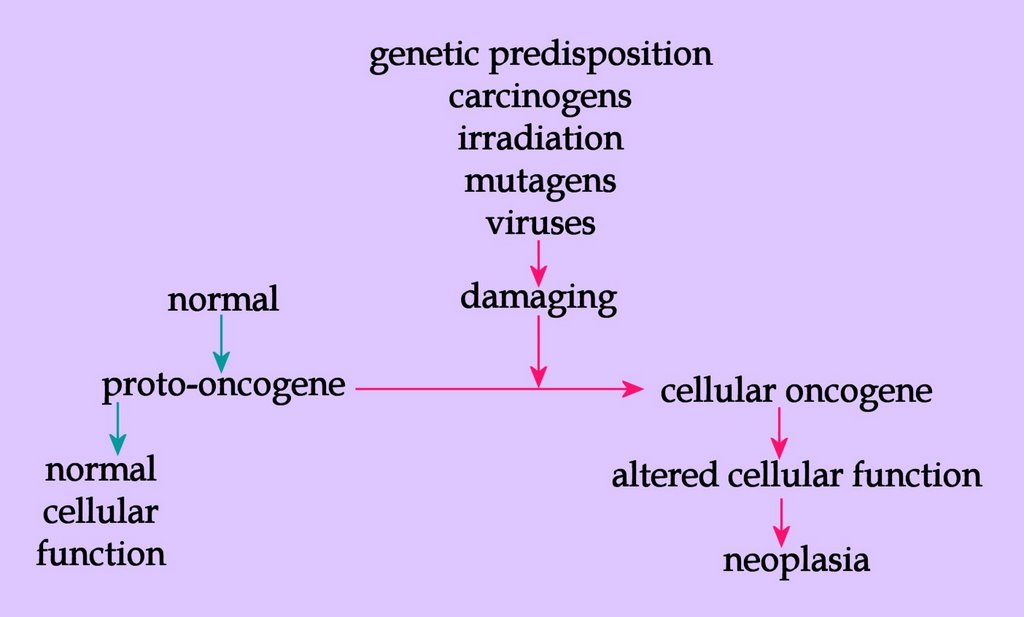
Alteration of a gene that usually controls cell growth can promote the uncontrolled growth characteristic of cancer. Proto-oncogenes are the normal forms of dominant genes that function in the various signal transduction cascades involved in regulation of cell growth, proliferation and differentiation – and the malignantly transformed versions of proto-oncogenes are termed oncogenes.

For example, mutation in a proto-oncogene, such as a gene that encodes an intracellular signaling protein that is normally activated only by extracellular growth factors, converts the proto-oncogene into an oncogene. The malignantly transformed oncogene encodes an altered form of the signaling protein that now behaves as though activated even in the absence of controlled growth factor binding. The malignant cell line has escaped normal gene regulation and cell cycle control mechanisms and exhibits unchecked proliferation.

There are many excellent sites with information for those affected by cancer, so the purpose of this site, in conjunction with the companion sites, is an exploration of the cell and molecular biology of malignancy.

synonyms : cancer, tumor, malignancy, neoplasm; cancerous, tumorous, malignant, neoplastic; cancer, neoplasia, oncology.

related items ¤¤ adenoviruses ¤ amplification ¤ carcinogenesis ¤ c-Fos ¤ c-Jun ¤ c-Myc ¤ c-Sis ¤ estrogen receptors ¤ gene amplification ¤ genetic predispositon ¤ HBV ¤ HIV ¤ HPV ¤ HTLV-I ¤ immune evasion ¤ irradiation ¤ malignant transformation ¤ metastasis ¤ mitogens ¤ mutagens ¤ MYC ¤ mutations ¤ neoplasia ¤ neoplastic mutations ¤ NF-κB ¤ non-mutagenic carcinogens ¤ oncogenes ¤ p53 ¤ proliferation ¤ proto-oncogenes ¤ radiation ¤ Ras ¤ Rb ¤ retroviral mechanisms of carcinogenesis ¤ retroviruses ¤ signaling molecules ¤ SRC genes ¤ T-antigens ¤ TP53 ¤ tumor antigens ¤ tumor suppressors ¤ tumorigenic viruses ¤ viral carcinogens ¤ v-Fos ¤ v-Sis ¤ v-Myc ¤

neoplastic mutations

Mutation of proto-oncogenes may convert them to oncogenes, while mutation of tumor suppressor genes may cause a loss of anti-proliferative functions.

Based on computational analysis of mutations affecting CAN-genes (candidate cancer genes) in breast and colorectal carcinomas, it has been estimated that cancers average 17 mutations (mostly SNPs) occurring within at least 90 genes []. Cancers originating in the same tissue display mutation of different genes, and mutated genes contributing to breast cancer are different from genes mutated in colorectal cancers. Many of the mutated genes are involved in pathways involved in cell adhesion, cell movement, and cell signaling. Because each of the affected pathways incorporates multiple genes, mutations in different genes within a pathway could have similar consequences.

G-T mismatch in the Ras proto-oncogene can cause an alteration of the amino acid at position 12 from glycine to valine, causing the Ras oncogene-encoded G-protein to remain continuously activated when it cannot release GTP. Mutations that prevent GTP hydrolysis favor constitutive activation as RAS-GTP, RasD. The commonest mutations are at the 12 (Gly→Val) → GAP insensitive, and the 61 positions → stabilizing against GTP hydrolysis.

The Consensus Coding Sequences of Human Breast and Colorectal Cancers.
The elucidation of the human genome sequence has made it possible to identify genetic alterations in cancers in unprecedented detail. To begin a systematic analysis of such alterations, we have determined the sequence of well-annotated human protein coding genes in two common tumor types. Analysis of 13,023 genes in 11 breast and 11 colorectal cancers revealed that individual tumors accumulate an average of ~90 mutant genes but that only a subset of these contribute to the neoplastic process. Using stringent criteria to delineate this subset, we identified 189 genes (average of 11 per tumor) that were mutated at significant frequency. The vast majority of these genes were not known to be genetically altered in tumors and are predicted to affect a wide range of cellular functions, including transcription, adhesion, and invasion. These data define the genetic landscape of two human cancer types, provide new targets for diagnostic and therapeutic intervention, and open fertile avenues for basic research in tumor biology. Sjoblom T, Jones S, Wood LD, Parsons DW, Lin J, Barber T, Mandelker D, Leary RJ, Ptak J, Silliman N, Szabo S, Buckhaults P, Farrell C, Meeh P, Markowitz SD, Willis J,
Dawson D, Willson JK, Gazdar AF, Hartigan J, Wu L, Liu C, Parmigiani G, Park BH, Bachman KE, Papadopoulos N, Vogelstein B, Kinzler KW, Velculescu VE. The Consensus Coding Sequences of Human Breast and Colorectal Cancers. Science. 2006 Sep 7; [Epub ahead of print] HHMI news.


[Analysis, identification and correction of some errors of model refseqs appeared in NCBI Human Gene Database by in silico cloning and experimental verification of novel human genes] [Yi Chuan Xue Bao. 2004] PMID: 15478601
Genetic alterations in the adenoma--carcinoma sequence. [Cancer. 1992] PMID: 1516027
Systematic identification of genes with coding microsatellites mutated in DNA mismatch repair-deficient cancer cells. [Int J Cancer. 2001] PMID: 11391615
Total-genome analysis of BRCA1/2-related invasive carcinomas of the breast identifies tumor stroma as potential landscaper for neoplastic initiation. [Am J Hum Genet. 2006] PMID: 16685647
Causes and consequences of microsatellite instability in endometrial carcinoma. [Cancer Res. 1999]

Top

oncogenes

Alteration of a gene that normally controls cell growth can promote the uncontrolled growth characteristic of cancer. The normal form of the gene is termed a proto-oncogene, and the malignantly transformed gene is termed an oncogene.

Oncogenes: c-Fos : c-Jun : c-Myc : c-Sis : Ras : Rb :
Tumor Suppressor Genes: TP53

Damaged genes are passed down through the cancer cell line, and may be dominant or recessive genes:

Recessive: tumor suppressors, growth suppressors, recessive oncogenes or anti-oncogenes. Malignant transformation can result from genetic damage to genes coding for growth factors, growth factor receptors and/or proteins for signal transduction cascades.

Dominant: Proto-oncogenes participate in a variety of normal cellular functions, but have the potential to tranform into cellular oncogenes when damaged. Proto-oncogenes normally function in the various signal transduction cascades that regulate cell growth, proliferation and differentiation. Cellular proto-oncogenes resident in transforming retroviruses are designated as c- (cellular origin) as opposed to v- (retroviral origin). Oncogenes are malignantly transformed proto-oncogenes - table  Oncogenes Proto-oncogenes

14-3-3 proteins are a family of highly conserved cellular proteins that play key roles in the regulation of central physiological pathways. More than 200 14-3-3 target proteins have been identified, including proteins involved in mitogenic and cell survival signaling, cell cycle control and apoptosic cell death. Importantly, the involvement of 14-3-3 proteins in the regulation of various oncogenes and tumor suppressor genes points to a potential role in human cancer. Tzivion G, Gupta VS, Kaplun L, Balan V. 14-3-3 proteins as potential oncogenes. Semin Cancer Biol. 2006 Jun;16(3):203-13. Epub 2006 Apr 1.

Oncogenes: c-Fos : c-Jun : c-Myc : c-Sis : Ras : Rb :
Tumor Suppressor Genes: TP53
Proto-oncogene/oncogene families ● growth factor genesreceptor tyrosine kinases ( RTKs) ● membrane ssociated non-receptor tyrosine kinases (PTKs) ● G-protein coupled receptors (GPCRs) ● Serine/Threonine Kinases ● nuclear DNA-binding/transcription factors

¤ Cancer ¤ carcinogenesis ¤ oncogenes ¤ proliferation ¤ p53 ¤ retroviruses ¤ Rb ¤ signaling molecules ¤ tumor suppressors ¤ tumorigenic viruses ¤ site map ¤ Tables  Oncogenes Proto-oncogenes  Malignant Transformation  Regulatory Proteins Sequences  Cell signaling  Cell Adhesion  Apoptosis vs Necrosis  Apoptosis 

Top