carcinogenesis
Carcinogenesis involves damage-induced genetic alterations (mutations) that produce cancers. Mutagenesis causes genetic alterations that may, or may not, result in cancer.
Tables Malignant Transformation Oncogenes Proto-oncogenes 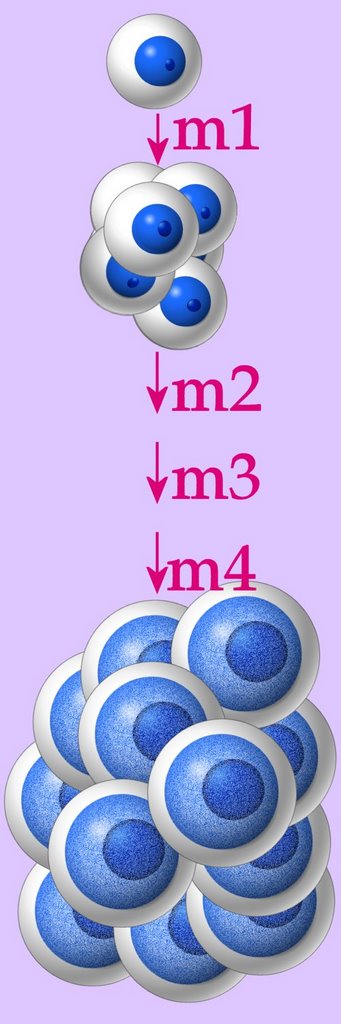 Many of the most powerful biological regulators of cell growth and proliferation are encoded by unstable mRNAs, which are targeted for rapid degradation by the cell. The loss of rapid degradation of these growth-promoting mRNAs can result in oncogenic transformation of the cell. Targeted degradation of proto-oncogene mRNAs and short-lived cytokines is controlled both by an AU-rich element (ARE) located in the 3' noncoding region, and by several proteins that bind the ARE sequence. Activation of the ARE for mRNA decay involves cotranslation of the mRNA by ribosomes, and employs the ubiquitin-proteasome pathway.[s]
Carcinogenesis typically results from a series of mutations that affect regulation of proliferation.
m1: inactivation of a tumor suppressor gene results in cell proliferation
m2: mutation inactivates a DNA repair gene
m3: mutation of a proto-oncogene generates an oncogene
m4: mutation inactivates more cancer suppressor genes, resulting in cancerous proliferation
Carcinogenic agents include:
Mutagenic carcinogens
Non-mutagenic carcinogens
Irradiation
Viruses (tumorigenic viruses) Transforming retroviruses and DNA tumor viruses encode oncogenes.
Genetic predisposition (Table of Hereditary Cancers)
Mutagenic carcinogens: ‘genotoxic’ carcinogens are DNA reactive and induce DNA damage. Tobacco smoke is probably the most notorious mutagenic carcinogen, producing, in addition to cardiovascular damage, cancers of the head and neck, lung, and bladder.
Non-mutagenic carcinogens: ‘non-genotoxic’ carcinogens are reported to have have significantly higher computed octanol/water partition coefficients than mutagenic carcinogens, suggesting that their ability to induce tumors may be associated with membraneous receptor sites and/or a longer residence time in the animal [r]. Estrogen can promote the growth of some breast cancers.
Irradiation:
Viruses: transforming retroviruses carry oncogenes mutated from cellular genes that are involved in mitogenic signaling and growth control. DNA tumor viruses encode oncogenes of viral origin that are essential for viral replication and cell transformation; viral oncoproteins complex with cellular proteins to stimulate cell cycle progression and led to the discovery of tumor suppressors. Viral systems support the concept that cancer development occurs by the accumulation of multiple cooperating events.[s]
Genetic predisposition: a variety of inherited genetic abnormalities render affected individuals more prone to malignancy. For example, hereditary non-polyposis colon cancer (HNPCC) is a form of colon cancer frequently associated with defects in the genes encoding MSH2 (about 35% of identified gene-defect cases) and MLH1 (about 60% of identified gene-defect cases). HNPCC is characterized by early age of onset and autosomal dominant inheritance with high penetrance. (Table of Hereditary Cancers)
∞ Cancer ∞ carcinogenesis ∞ oncogenes ∞ proliferation ∞ retroviruses ∞ signaling molecules ∞ tumorigenic viruses ∞ site map ∞
Tables Apoptosis vs Necrosis Apoptosis Cell Adhesion Cell signaling Malignant Transformation Oncogenes Proto-oncogenes Regulatory Proteins Sequences Table of Hereditary Cancers .
▲ Top ▲


